Your Successes

What Will Your Story Be?

Why isn't everyone doing this? Doesn't everyone have Feel?

We learn practices steeped in the wisdom of the old masters, who took the time to record their discoveries so that those that followed might find their way more easily. This is wise, I would say, and the gift of experience, expertise and knowledge handed to us. I was (and am still) a student of their works, under the guidance of excellent coaches in France, then England for 30 years. 

Until a horse came along with a clear message: there's more Karen. 

Chase was right and the hundreds of horses that followed agreed with him.

Did the old masters mean their works to be considered the end of the story? Far from it, I believe. Read about William Cavendish, Duke of Newcastle and we find that his passion for expanding his understanding of horses continued well beyond what was published. Baucher's story is similar and we only have the gift of his later findings thanks to his student. In his book "True Horsemanship Through Feel", Bill Dorrance writes that he studied those masters for the fifty years leading up to the publication of his own work and notes that he "almost didn't live long enough to understand this". These are not the words of a man who thought he'd figured it all out.

Our horses are calling us to go a little deeper. Evolve our work with horses. Because there's more in them, so much more.

In a journey under Chase's guidance, first into the Abyss, then to Bliss, he had a clear message of horse wisdom about what I had missed. And was missing out on.
 

  • © Karen Musson, Art of Riding LLC. All rights reserved.

If you are not born an Alpha style leader, your horse will know it. It can come across to your horse a bit like a lower ranking horse in the herd trying to move up the ranks, but lacking the presence, clarity and sureness to succeed. A less "Alpha" person will quite likely (consciously or unconciously) put off escalating the pressure, perhaps because they don't really feel good about it or just want to delay as much as possible to give the horse a chance, The trouble is, just like the lower herd member seeking to move up a rank, holding off can come across as hesitation, leading directly to the need to deliver greater pressure, which would require even greater sureness to be effective. This is a Catch 22, because the source of sureness in dominance is not hesitation.

  • © Karen Musson, Art of Riding LLC. All rights reserved.

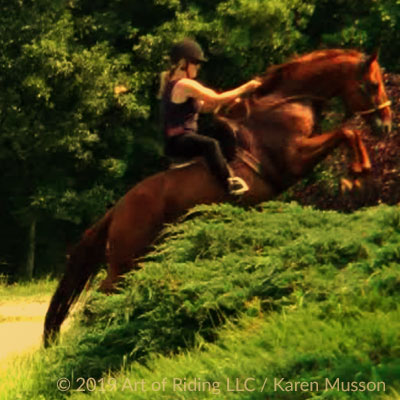
If Chase hadn’t made me jump – literally – with a surprise launch 5ft into the air from a standstill over a 15ft span, I might not have woken up from my fog, to get his real point.

chaseJump400x400For three years I had grappled with a relentless echo on my mind. “What am I missing Chase? …What am I missing?”

Fun had become a faded memory. I’d failed to understand Chase well enough (by quite a margin) for our partnership to take off. I think I’d lost hope I ever would, or could.

I had continued evolving the skills I’d developed over 30 years from top coaches in Europe and the USA. Still I was no closer to the true connection I sought with Chase. And that’s what mattered to me most. It always had.

Was the exquisite ease of connection I had with my beloved event mare in my teens just a special thing with that “one” horse?

It was clear Chase didn’t enjoy our time together much, which slowly chipped away at my soul, is the truth. It felt like he went along with the hand-brake on, in mind and body.

Then that day I asked Chase to walk up a slope. Simple. He looked down to point out (correctly actually) that the gap between the shrubs had narrowed – and that “I don’t do prickly Karen!”

I admit I didn’t fully get that part and suggested “no worries, you can go”.

So… he cleared the shrubs from a complete standstill (as I grabbed his mane to stay with him!).

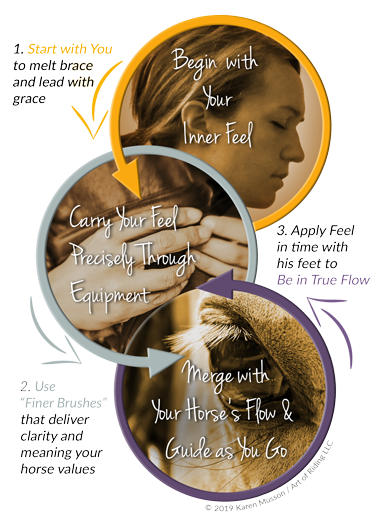
TrueFlowModel5PORTRAITNoTitle378x522

Think about this. At one time the best “forward” I had was Chase wishing he were somewhere else every step. Yes it was that bad! But now, this time, he knew what I wanted. He didn’t think he could do it and found a way to go anyway – with palpable generosity and wide open heart that flooded every cell in my body as we took off.

Such a joy and so exhilarating, as I blinked wet eyes clear, we went round and jumped three more times! Everything I had dreaded might never be – and much more than I somehow imagined – was right there.

It hadn't been some big, intangible thing I had to change, just smaller things to refine. When I got enough of those smaller things right, enough of the time, for long enough, they combined (rather literally) to launch us from the Abyss. And from there it just got better and better.

The “little things” had changed everything, for good: the gateway to Bliss.

And it’s here for you, too.

  • © Karen Musson, Art of Riding LLC. All rights reserved.

TrueFlowModelHorseFlow400x400 31Now we have our ‘higher bandwidth’ connection and have fine-tuned the Feel we present through our tools, we need the third key to add clarity, even value, from the horse’s viewpoint.

Virtually every problem that arises in our handling of horses and riding boils down to one small thing:

Where does the next foot go next? And... how does it Feel between you and your horse?

If a horse is concerned, he steps away. If he takes over, his next foot goes off course. If he needs to save himself, his next foot might go higher or further than expected.

Convention teaches us to direct or correct the horse ‘against’ the flow of the horse’s feet, through our use of pressure. Our timing is ahead of or behind the horse’s own flow: we’re early or late!

We miss the horse’s timing. And we miss the most important thing to a prey animal: where he needs to put his feet, when and how fast to feel safe. It’s how he is wired. Conventional pressure and its timing challenges a decision the horse already made to fulfill his core need vs. guide him to provide for that need. We erode his trust, confidence and interrupt Flow.

Get With My Feet!

When we find out how easy (really!) it is to guide our horse’s feet from within his Flow instead, it has a dramatic effect on the horse’s trust and confidence as well as inspiring his interest in what we do together – it feels like a private conversation with his most deeply-wired awareness.

The conventional ‘red pen’ focus on what must be corrected or isn't right yet shifts and we enter instead the deep now of true connection. 

As a student posted, “You have shown me the door to Wonderland”.

Take a look at some simple adjustments in your Feel you can try to help your horse at home.

  • © Karen Musson, Art of Riding LLC. All rights reserved.

TrueFlowModelEquipment400x400 31This open connection we initiate feels like ‘higher bandwidth’ access to our horse came available. With this comes the second key: the opportunity to refine our use of our tools.

Conventionally a carefully timed release of pressure highlights the desired response and rewards the horse. Much can be achieved this way, so where’s the problem?

Say we ask our horse to yield his hind-quarters – for example by directing pressure towards the hip using the end of the lead-rope – and the horse steps over. Did he follow our Feel or avoid its promise of pressure?

If we then reward him immediately by dropping the pressure like a hot potato, to emphasize his correct response, what does the horse actually experience as the reward? A dropped connection from us. Wait! Didn’t we want to build a closer connection?

When our Feel includes a series of “connection hang-ups”, like a bad cell phone connection, the depth of conversation will take on a natural limit and lacks Flow.

Don’t Hang Up on Me!

When we add finer brushes to our art, our expression becomes clearer, more refined and our brace gives way to grace.

We do this through simple presentations of Feel in the rope/rein between your hand and the horse’s halter/bridle. We combine these skills with a set of releases that shape and direct without pushing pressure from us towards the horse - and without the dependendce on preceding pressure to release. 

This allows our Feel to go through the horse’s body to his feet, instead of to the body and at his feet.

  • © Karen Musson, Art of Riding LLC. All rights reserved.

More Articles …