
Our horses are calling us to reach a little deeper, evolve our way of working to reach more in them, so much more.
We know it's there, but it seems just out of reach or sometimes impossible to reach, despite our sincerely best effort.
So how do you experience the kind of connection that has real meaning to you and your horse and leaves you both warm and glowing inside? How can you bring that consciously and reliably into your partnership with your horse, not just in fleeting moments that are hard to explain or repeat?
The simple answer (isn't it always in the end?) is that we need to shift our Feel and Timing to be in Flow with our horse instead of against his Flow.
What does this mean?
What exactly is off in our Feel and Timing?
Perhaps nothing! It depends on the partnership outcome we seek. If we want a deeper connection, let's think about feel and timing as it relates to developing that aspect of our partnership. How would our horse rate our Feel in terms of inviting and maintaining a close connection?
For example, if I have to pressure you to do something because you haven't done it yet, we are not quite on the same page. If I pressure you as a way to correct what you just did, we are not on the same page then either. There is a disconnect. And I'm applying pressure in response. There's no doubt that this use of pressure can be effective. The question here is: where is the invitation to connect? Where is the invitation to stay connected?
And what about the "hot potato" release of pressure we offer, in our effort to mark clearly that desired response? Where is the invitation to connect or stay connected in terms of the Feel we are offering?
So often, the use of pressure and its release interrupts the Feel of connection, even though that is not our intention at all.
Making the wrong thing difficult is against his flow.
Reward the slightest try or receive the offer?
If I have to pressure you to do something because you haven't done it yet, we are not quite on the same page are we? If I pressure you as a way to correct what you just did, we are not on the same page then either. So often, the use of pressure interrupts the connection, even though that is not our intention.
The Feel and Timing in these presentations, while obviously what most of us are taught, tend to focus on a (lacking) future result or the correction of a (lacking) past result. But what about the horse's timing? He is focused on his experience right now, in the present - so we are not quite with him in his own Flow.
Our requests are slightly behind or ahead. And it can feel a bit like we have a "red pen" in our hand, so to speak, having made it our job to "pass" or "fail" the horse as he tries to do as we ask. We want him to pass of course. We watch for his "slightest try" - but do we acknowledge his try or receive his offer? We appreciate what we see, we like it, but do we Feel it? Or do we Feel... what was missing? This sounds like a tiny difference, yet it is substantial. Feel is meaningful to horses and our Feel carries our meaning either way, whether we are aware of it or not!
For example, if we think the horse's effort was lacking in some way or (more often!) our own effort was lacking, it doesn't actually matter: either way this is in the Feel between you. It defines the partnership experience in that moment. And "not enough" doesn't feel good to either party. Moments like this can add up. The more there are, the greater the gap will be felt in the connection.
Make the wrong thing difficult or the right thing the most obvious thing to do?
Does "making the wrong thing difficult" Feel like we seek or want a better connection? If he has sort through the wrong things to find his way to the right thing, how does that Feel to him? If it is our habit to focus on the wrong things, how does that Feel to him, over time? What if we stopped promising pressure and committed to making the right thing so obvious he has not doubt what we ask?
Release of Pressure or Ongoing Feel of Release?
We are taught to initiate a request with pressure, then release pressure with careful timing to mark the desired response. For example, I put a little pressure towards the horse's hip to step him over. I release for a step. Does that "hot potato" release Feel like an invitation to connect? Or has the reward somehow become associated with a Feel of disconnect?
Does this Apply to You and Your Horse?
If any of these questions raised your eye-brows a little, you are probably seeking the deeper type of connection with your horse that is just plain hard to reach, due to our own choice of Feel and Timing. It's more than proven that horses learn this way, but there are aspects to these common practices that actually get in the way of a closer connection. We are a bit behind or a bit ahead of their own experience, while carrying that "pass/fail" red pen!
"Ok, so how do we get with him, how do we get our Feel and Timing in Flow?"
Getting in Flow itself is effortless and will happen naturally, when certain practices or conditions are in place. Here are the "threads" that weave together to produce Flow:
- a good feel about this moment
(you have a plan that feels within reach and a passion for it in your veins) - a good feel about what is about to happen
(you can envision the Feel of a successful outcome) - a dose of healthy respect for the risks we take
(we aren't riding a rocking horse :) - observation and well-practiced interaction with the micro-details or particles of feel involved
(the deeper our familiarity the more effortless our awareness of the details in real-time) - a plan, a decision and stream to flow in
(just something you want to do with your horse!) - a chance to 'embody' or truly take in an experience after it happens
(mulling things over fuels 1-3 above)
"That sounds like a tall order doesn't it?"
If we view success as completely mastering 1-6, then it could quite likely seem overwhelming.
But what if success is not just measured by completion of the end-goal, but by the quality of this moment, right now and the adjustments we will make for the next moment to be better and so on? What if we measure our success along a scale of how the partnership feels, by tracking our progress within a set of elements needed for those quality moments come through?
What is it for you?
Is it reaching a certain milestone and being fueled by the desire to get there? Or are you like me and that just feels like icky pressure until you get to the desired result? Then, before you've felt that moment of success you've re-focused onto the next thing that is not working yet!
It just depends on the person, doesn't it. Some people genuinely thrive on the pressure to achieve an end-goal.They love it.
For me, this is not motivating. The end-goal ("I've so far failed to achieve") fuels lingering dis-ease or resentment or slides me into 'going through the motions' and wishing I could just be at the end goal. It's not fun!!
There is no right or wrong here, just different wiring. About 75% of people are motivated by external (extrinsic) rewards, while 25% are motivated by the fulfilling or good feel (intrinsic) experience itself. Interestingly it has been found that extrinsic rewards can actively be de-motivating.
This applies to our horses too! We are taught that horses need the incentive of pressure or a food reward end-goal to be motivated to learn. They can learn that way, when they perceive the end-goal (release of pressure, perhaps a treat) feels better than the pressure, so they reach for it. However, just like us, they have a high interest and capacity for learning 'just because' the experience itself feels good.
Better still, how about both!
What if we chose to measure success, not in terms of the end-goal, but instead the quality of this moment, how much it is enjoyed and how much it contributes and supports that ultimate goal?
Then it would be easy to put the time in wouldn't it, because it's time put to the joy of the moments and the moments that add up to defining the parternship experience, rather than (for some of us) time spent feeling crappy because we aren't where we wanted to be yet! Who wants to spend time doing that?
The thing is, not to just wait around hoping for those to happen, but to gain mastery in creating those moments, so that every encounter you have with your horse is rich with them and ultimately the whole partnership experience itself is just one big fat ongoing dose of them!
For that we do need a plan. We don't plan to fail, as they say, we fail to plan.
"
In a nutshell, we need to get with him by in an open connection and get with the timing of his feet.
Everything we do, we do better in Flow because our awareness is activated.
We naturally (and automatically) disregard the unimportant, narrow our focus and become deeply present. Horses love the Feel of this because we are so much closer to their awareness of the particles of Feel in the connection and what matters right then, to them.
Clarity in that moment between you is all that is left.
Do you see it in this horse’s expression (below)? He doesn't just do what I ask, he follows a Feel I connect through his mind to his feet. I offer this Feel within his Flow, right then. I can feel his mind in my fingers tips. He is 100% with me on my plan to lead him off.
The true Feel of a horse feeling back to you like this is exquisite. Once felt, it's never forgotten nor does it ever get old!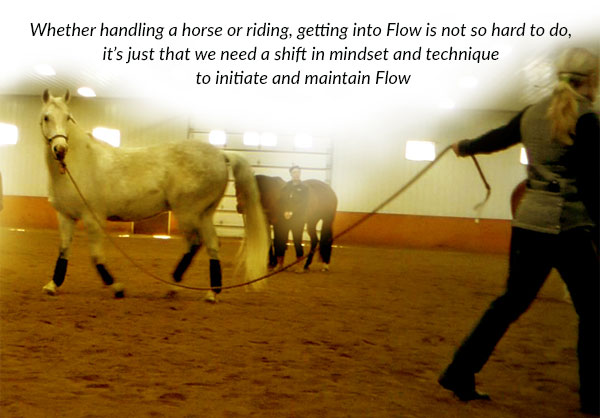
Whether handling a horse or riding, getting into Flow is not so hard to do, it’s just that we need a shift in mindset and technique to initiate and maintain Flow.
Why isn't everyone doing this? Doesn't everyone have Feel?
We learn practices steeped in the wisdom of the old masters, who took the time to record their discoveries so that those that followed might find their way more easily. This is wise, I would say, and the gift of experience, expertise and knowledge handed to us. I was (and am still) a student of their works, under the guidance of excellent coaches in France, then England for 30 years.
Until a horse came along with a clear message: there's more Karen.
Chase was right and the hundreds of horses that followed agreed with him.
The simple truth (isn't it always in the end?) is that experiencing this heightened sense of connection happens effortlessly, when you enter Flow together.
“Flow? Isn’t that something reserved for the gifted Olympic athlete?”
Actually you probably know Flow well.
Think of something you love to do (it could be anything from mountain climbing to an art project or gardening), where action and awareness seem to merge and you lose sense of time. You even lose your sense of self, as the line between you and what you’re doing seems to vanish from your awareness. That’s when you’re in Flow. It's an effortless state that happens naturally when a certain combination of factors occur together.
Anyone can experience Flow - and being in a state of true Flow is a wonderful way to be with your horse. Not just 'flowy' in a long mane, poetic way, where there may or may not actually be true connection, but mutual Flow, which is more like a merging of mind and body in a way that is conscious, deliberate and predictable.
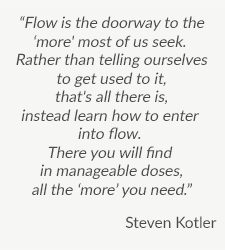
“In flow, every action, each decision, leads effortlessly, fluidly, seamlessly to the next.”
Steven Kotler, Director of Research, Flow Genome Project
Did the old masters mean their works to be considered the end of the story? Far from it, I believe. Read about William Cavendish, Duke of Newcastle and we find that his passion for expanding his understanding of horses continued well beyond what was published. Baucher's story is similar and we only have the gift of his later findings thanks to his student. In his book "True Horsemanship Through Feel", Bill Dorrance writes that he studied those masters for the fifty years leading up to the publication of his own work and notes that he "almost didn't live long enough to understand this". These are not the words of a man who thought he'd figured it all out.
In a journey under Chase's guidance, first into the Abyss, then to Bliss, he had a clear message of horse wisdom about what I had missed. And was missing out on.